
The Style AtelierWomen’s Tops · Thane Edition

The Material World of Women’s Fashion

Before a top is a style, it is a material. Fibre, weave and finish decide how it feels, falls, breathes and ages.

This archive gathers what is useful to know about the fabrics, colours, prints and construction details you’ll meet in women’s tops. The descriptions are general tendencies — weight, weave, blend and finishing all change how a fabric behaves — so always read the care label of the garment in your hands.

  1. AFabric library12 specimens
  2. BColour intelligence9 families
  3. CPrints & patterns8 studies
  4. DConstruction10 details

Drawer A

Fabric library

Twelve specimens, each filed with its typical texture, drape, breathability, comfort, appearance, care and common uses in women’s tops.

  1. F-01 Cotton
  2. F-02 Linen
  3. F-03 Rayon
  4. F-04 Viscose
  5. F-05 Polyester
  6. F-06 Chiffon
  7. F-07 Georgette
  8. F-08 Satin
  9. F-09 Crepe
  10. F-10 Silk
  11. F-11 Knitted fabrics
  12. F-12 Blended fabrics
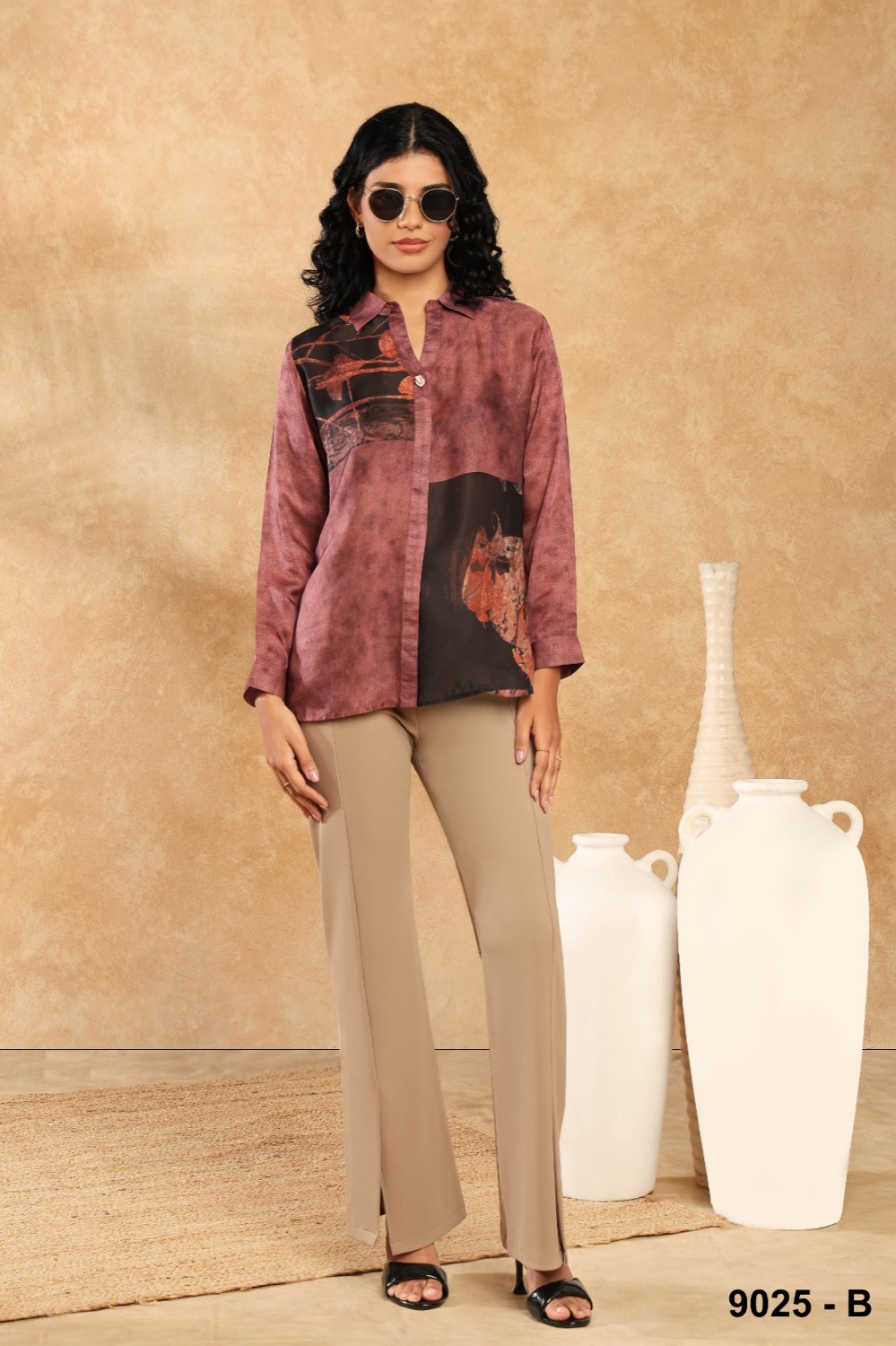
Woman in a long-sleeved dusty-rose shirt with a mottled ground and abstract black and rust painted panels, worn with beige trousers
Drape studyLook 9025-BA soft, fluid shirt hangs from the shoulder in long vertical folds — drape you can read before you touch it.

F-01 · Natural plant fibre

Cotton

The everyday fibre. Woven as poplin, voile, cambric or mulmul, it ranges from crisp to whisper-soft.

Texture
Matte; soft to crisp depending on weave
Drape
Moderate — voile flows, poplin holds shape
Breathability
High; absorbs moisture well
Comfort
Gentle on skin and cool in humid weather
Appearance
Clean and natural, casual to smart
Care
Often washable; may shrink or crease — check the label
In tops
Everyday tops, shirts, summer workwear
F-02 · Flax fibre

Linen

Dry, cool and textured, with visible slubs. Its creases are part of its character.

Texture
Dry, slubby, slightly crisp
Drape
Crisp at first, softening with wear and washing
Breathability
Very high
Comfort
Cool and airy; creases easily
Appearance
Relaxed, natural sophistication
Care
Gentle wash; iron damp or embrace the creases
In tops
Summer shirts, relaxed tops, resort wear

F-03 · Regenerated cellulose

Rayon

Made from processed plant cellulose, rayon is soft, cool and fluid, and takes print and colour vividly.

Texture
Soft and smooth
Drape
Fluid
Breathability
Good
Comfort
Cool against the skin; weaker when wet
Appearance
Rich, saturated prints
Care
Gentle or hand wash; may shrink — follow the label
In tops
Printed tops, flowy casual tops

F-04 · A type of rayon

Viscose

Viscose is rayon made by a particular process. It shares rayon’s softness and drape, often with a gentle lustre.

Texture
Silky-soft
Drape
Fluid, moves easily
Breathability
Good
Comfort
Light and cool
Appearance
Matte to softly lustrous; good colour
Care
Gentle; avoid wringing and high heat
In tops
Blouses, wrap tops, printed shirts

F-05 · Synthetic fibre

Polyester

Versatile and resilient; it can be engineered to resemble satin, crepe or georgette.

Texture
Varies widely with construction
Drape
Depends on weight and weave
Breathability
Lower than natural fibres; can feel warm in humidity
Comfort
Durable, crease-resistant, quick-drying
Appearance
Holds colour and pleats well
Care
Easy-care; iron on low heat
In tops
Formal tops, partywear, travel-friendly pieces

F-06 · Sheer plain weave

Chiffon

Lightweight and sheer, woven from silk or synthetic yarns. Often layered or lined.

Texture
Soft, slightly grainy, transparent
Drape
Floaty
Breathability
Airy
Comfort
Very light; usually worn with a lining or camisole
Appearance
Ethereal and romantic
Care
Delicate; hand wash or dry clean
In tops
Overlays, sheer sleeves, evening tops

F-07 · Crepe-textured sheer

Georgette

Woven with twisted yarns for a crinkled, matte surface. A little more body than chiffon.

Texture
Grainy, finely crinkled
Drape
Fluid with graceful movement
Breathability
Good
Comfort
Less clingy than many smooth fabrics
Appearance
Matte and elegant
Care
Gentle wash; low heat
In tops
Flowy, festive and printed tops

F-08 · A weave, not a fibre

Satin

A weave that floats yarns across the surface for a smooth, glossy face. It can be made from silk, polyester or blends.

Texture
Slick and smooth
Drape
Fluid to structured, by weight
Breathability
Depends on fibre; synthetic satin can feel warm
Comfort
Smooth on skin
Appearance
Reflects light; colours look richer
Care
Low heat; handle gently to avoid snags
In tops
Evening tops, satin shirts, wrap tops

F-09 · Textured surface

Crepe

Defined by a pebbly, matte surface created by twisted yarns or a special weave.

Texture
Grainy and matte
Drape
Smooth fall; tends to resist creasing
Breathability
Moderate
Comfort
Comfortable for long days
Appearance
Refined and polished
Care
Usually easy; some crepes shrink — follow the label
In tops
Office tops, structured blouses

F-10 · Natural protein fibre

Silk

The original luxury fibre, prized for its natural lustre and the way it holds colour.

Texture
Smooth and luxurious
Drape
Fluid
Breathability
Good; comfortable across temperatures
Comfort
Light; can show water and perspiration marks
Appearance
Natural lustre, deep colour
Care
Delicate; dry clean or hand wash as labelled
In tops
Occasion tops, elevated essentials

F-11 · Interlooped yarn

Knitted fabrics

Jersey, rib and interlock are made by looping yarn rather than weaving it, which gives natural stretch.

Texture
Soft and stretchy
Drape
Skims or clings, by weight
Breathability
Good in cotton-rich knits
Comfort
Moves with you; easy to wear
Appearance
Casual to sleek
Care
Wash gently; dry flat to keep shape
In tops
Tees, fitted and wrap tops, layering pieces

F-12 · Two or more fibres

Blended fabrics

Cotton-polyester, viscose-linen, cotton with elastane: blends combine the strengths of different fibres.

Texture
Varies with the mix
Drape
Varies with the mix
Breathability
Depends on fibre proportions
Comfort
Often adds stretch or crease resistance
Appearance
Typically easier to keep neat
Care
Follow the label — usually set by the most delicate fibre
In tops
Workwear, travel tops, everyday basics

Drawer B

Colour intelligence

Colour is the fastest way to change the mood of a top. A few principles help: pair a strong colour with a quiet one; repeat one shade from a print elsewhere in the outfit; and use texture to give single-colour looks depth.

Below, nine colour families and how they combine with the rest of a wardrobe.

  1. White & ivory

    Fresh and luminous. Bright white reads crisp; ivory and off-white read softer and warmer. Both reflect light toward the face.

    Combine withDenim of every wash, black, navy, camel, and any print that contains white.

  2. Beige & neutral shades

    Sand, taupe, stone and mushroom. Endlessly versatile, they let fabric and cut become the focus. Several of the trousers on this site are in these shades for exactly that reason.

    Combine withWhite, chocolate, black, olive, and gold-toned accessories.

  3. Black & charcoal

    Graphic, sharp and dependable for evening. Charcoal is a softer alternative for daywear and works well against grey and denim.

    Combine withWhite, camel, red, metallics, or black for a sleek monochrome.

  4. Pastels

    Powder pink, lilac, mint and butter. Gentle in daylight; modern when set against a deep neutral rather than another pastel.

    Combine withWhite, grey, navy, beige and light denim.

  5. Reds & pinks

    From wine and pomegranate to rose and blush. Deep reds read rich and evening-ready; pinks range from soft to vivid fuchsia.

    Combine withBeige, white, black, navy, and — for confident dressers — pink with red.

  6. Greens

    Olive, sage, celery and teal. Greens feel natural and calm, and jewel-toned greens like teal look striking in satin.

    Combine withCream, brown, black, rust and soft pink.

  7. Blues

    Navy works almost like a neutral; cobalt is a statement; powder blue is fresh and soft. Blue tops sit naturally with denim for tonal looks.

    Combine withWhite, beige, grey, tan and blush.

  8. Earthy colours

    Rust, terracotta, mustard, khaki and coffee — warm, grounded and easy to wear across seasons, as the rust casual top in our collection shows.

    Combine withCream, chocolate, denim, olive and gold.

  9. Bright statement colours

    Vermilion, marigold, fuchsia and electric blue. Let one bright colour lead and keep the rest of the outfit simple.

    Combine withBlack, white, navy, or a deeper tone of the same colour.

Drawer C

Prints & patterns

A print changes how a top is read from across a room. Scale, contrast and spacing matter as much as the motif itself: small, tonal prints read quietly; large, high-contrast prints read loudly.

Floral prints

From delicate ditsy flowers to oversized blooms. Small florals feel classic; large ones feel modern and romantic.

Geometric patterns

Triangles, checks, chevrons. Ordered and graphic; they look sharp with solid, tailored bottoms.

Abstract prints

Brushstrokes and colour fields, like Look 9025-B above. They feel artistic and pair well with a colour pulled from the print.

Stripes

Vertical stripes elongate; horizontal stripes feel nautical and casual; diagonal stripes on a wrap add movement.

Polka dots

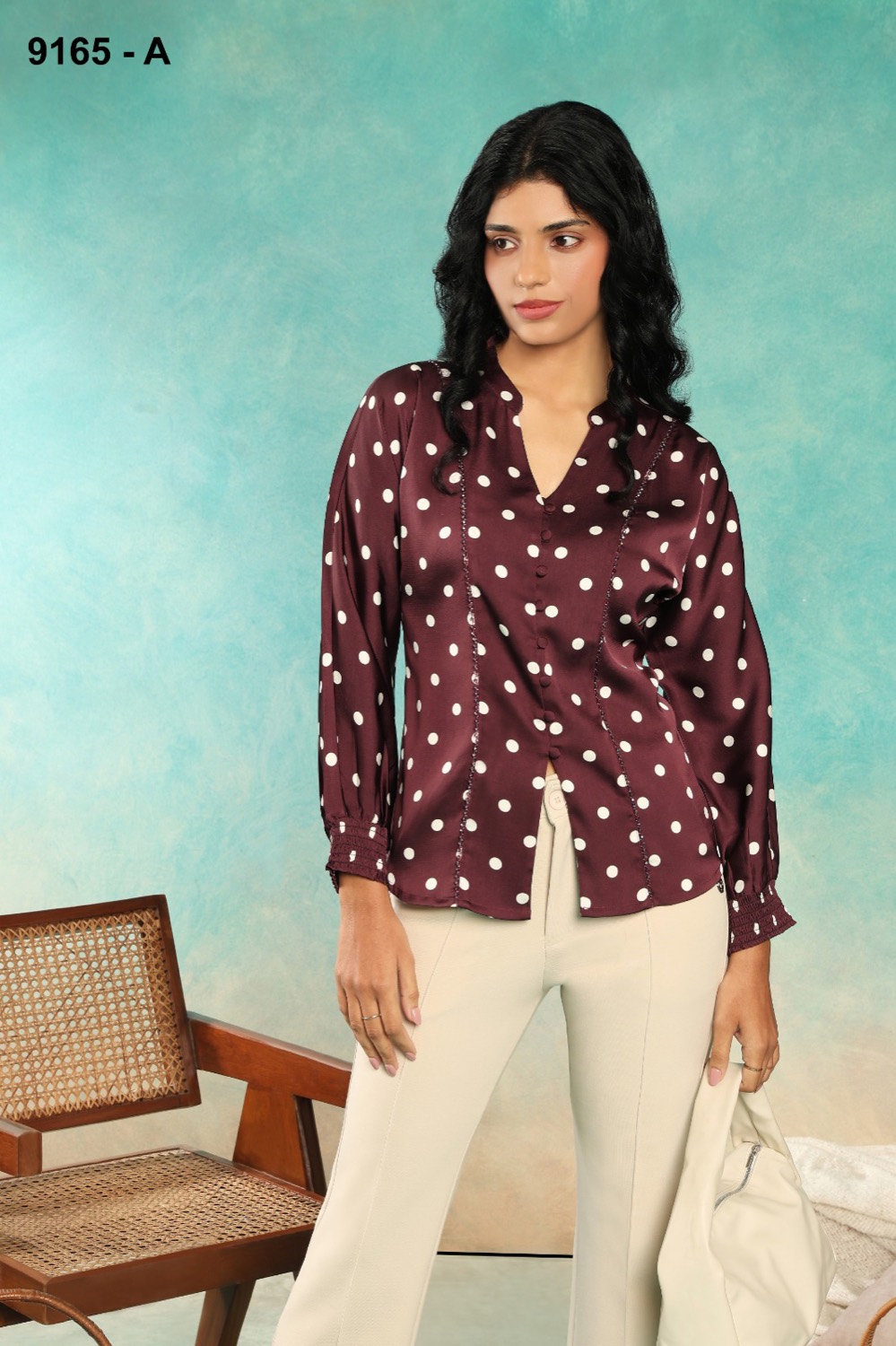
Playful when large, refined when small. On satin, dots take on a vintage-glamour feel — see Look 9165-A below.

Animal-inspired prints

Zebra, leopard and snake motifs. Treat them as a neutral with attitude: one per outfit is enough.

Minimal patterns

Pinstripes, micro-checks and tiny motifs that look almost solid from a distance — ideal for the office.

Solid colours

The absence of print puts the attention on colour, fabric and cut — and makes accessorising easy.

Drawer D

Construction & garment details

How a top is made affects how it looks, fits and lasts. You don’t need to be a tailor to notice good construction — just know where to look.

Woman in a wine satin shirt with white polka dots, a V-neckline, covered buttons and lace trim set into the seams, worn with ivory trousers
Look 9165-AWine satin with polka dots: covered buttons, trim set into the seams, a faced V-neckline.
Garment construction details and what to look for
Ref.DetailWhat it is & what to look for
D-01StitchingThe thread that holds the garment together. Look for even, straight stitches with no loose ends or puckering, especially along visible topstitching.
D-02SeamsWhere panels join. Neat, flat seams with finished edges inside the garment (overlocked, French or bound) wear better. Seams can also be decorative — trim set into a seam, as on Look 9165-A.
D-03HemsThe finished lower edge. A smooth, even hem that doesn’t ripple or twist helps a top hang correctly; curved shirt hems should follow their line cleanly.
D-04ButtonsFunctional and decorative. Securely sewn buttons and cleanly finished buttonholes matter; covered buttons in the garment’s own fabric give a refined, seamless look.
D-05ZippersConcealed (invisible) zips at the side or back keep fitted tops sleek. A good zip lies flat and runs smoothly without catching fabric.
D-06PleatsFolds that release fullness — knife, box or inverted. Pleats at the waist or shoulder add shape and movement; they should be even and stitched securely.
D-07DartsTapered folds that shape flat fabric around the body, usually at bust, waist or back. Well-placed darts give a fitted top its contour without pulling.
D-08EmbellishmentsEmbroidery, appliqué, sequins, beads and lace. Check that they are attached firmly and sit flat, and consider how they affect washing.
D-09Neckline constructionFacings, bindings or collars that finish the neck edge. A well-built neckline lies flat, keeps its shape and doesn’t gape or roll outward.
D-10Fabric finishingTreatments applied after weaving — softening, pre-shrinking, anti-crease or printing. Finishing affects hand-feel and care, so it’s worth reading the label.

Material understood? See how fabric and colour translate into outfits.